Low‑pressure axial compressor of An aircraft turbojet engine
RoboticsThe uniqueness of the development lies in reducing the dimensions and weight of the axial compressor of the aircraft bypass turbojet engine by integrating the flow path of the low‑pressure compressor guide vanes into the flow path of the downstream intermediate casing, while maintaining the aerodynamic efficiency of their flow paths.
- Innovator(s)
- M.R. Valeev, A.R. Teregulov
- Organisation
- JSC “UEC-UMPO”
- Country
- Russia
- Exhibition zone
- Product Arena
- Technology Readiness Level
- TRL 5 of 9
- Edition
- INEX 2026
About this innovation
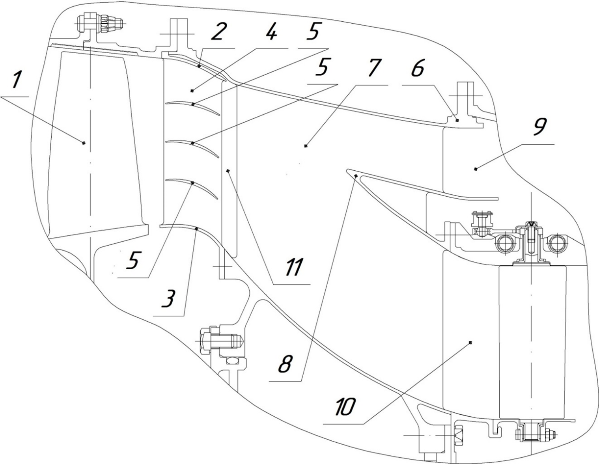
A low‑pressure axial compressor of an aircraft bypass turbojet engine contains a blade wheel 1 and guide vanes made of outer 2 and inner 3 coaxial casings, which are connected to each other by airfoil-shaped vanes 4 installed in the radial direction and connected to each other via coaxially installed rows of airfoil-shaped vanes 5. When the blade wheel rotates, the air flow approaching its blades at a relative speed is decelerated in the blade passages. At the blade wheel outlet, the air flow has a significant residual swirl in the circumferential direction, which is eliminated in the guide vanes located in the flow path 11 of the intermediate casing 6 in the axial clearance between the blade wheel and the support struts 7. The complex spatial shape system of channels in the guide vanes, formed by the airfoil-shaped vanes, gives the air flow the required direction angle and also unseparated movement into the flow path of the intermediate casing with a divider 8, where it is divided into the flows of the bypass 9 and core 10 engine ducts.
The uniqueness of the development lies in reducing the dimensions and weight of the axial compressor of the aircraft bypass turbojet engine by integrating the flow path of the low‑pressure compressor guide vanes into the flow path of the downstream intermediate casing, while maintaining the aerodynamic efficiency of their flow paths.
Location of the guide vanes in the intermediate casing flow path makes it possible to reduce the distance between the blade wheel and the support struts, decrease the length and weight of the low‑pressure rotor, and, consequently, reduce the dimensions and weight of the axial compressor.
Compared to well-known designs of low‑pressure axial compressors for aircraft bypass turbojet engines, the presented development possesses decreased dimensions and weight while maintaining the aerodynamic efficiency of the flow path.
It is applied in the gas turbine engine design.